
Prev
Click the blue text and follow us
✦
JUMBO SHEEN
INVESTMENT
✦

In Beijing this August, two major events opened one after another.
On August 19, the 2026 World Robot Conference (WRC) kicked off in Yizhuang under the theme “Human‑Robot Symbiosis, Integration of Production and Demand”. Three days later, the 2nd World Humanoid Robot Games commenced at the National Speed Skating Oval, known as the “Ice Ribbon”, featuring 666 teams and 2,056 robots competing side by side.
Whereas audiences cheered last year at robots that could “run and jump”, this year’s focus has quietly shifted — from “showcasing gimmicks” to “getting work done”, and from “demonstrations” to “deliveries”.
For investors, this is far more than a mere technology show. It marks a concentrated inflection point for the industry. Drawing insights from these two landmark events, this article outlines the real‑world dynamics, growth trajectory, investment strategies and critical risk factors to monitor across the robotics sector.
Core Thesis
2026 marks the first‑year milestone for humanoid robots, transitioning from pilot production at the thousand‑unit scale to mass delivery on the ten‑thousand‑unit scale. The sector is seeing a financing boom on the capital front, accelerated localization of supply chains, and the initial formation of commercially viable closed‑loop deployments in industrial scenarios. Nevertheless, edge‑side AI chips, embodied large models and high‑precision sensors remain universal bottlenecks. For investment allocation, priority should be given to “pick‑and‑shovel players” (core components). Investors shall select leading system integrators prudently, keep an eye on embodied‑intelligence algorithms and data infrastructure, while staying alert to valuation bubbles and risks stemming from divergent technology roadmaps.
Ⅰ. From Spectacle to Practical Deployment: Inflection‑Point Signals from the Two Landmark Events
Take the WRC first. This year’s conference brought together over 300 exhibitors, representing a roughly 36% increase from the previous edition. More than 3,000 exhibits were on display, including 311 debut products and 44 newly unveiled technologies and solutions. Expanded scale is only superficial. What truly stands out is the inaugural “Procurement Day”, a clear signal that both organisers and exhibitors are pro‑driving the shift from “viewing” to “purchasing”.
Changes on the show floor spoke for themselves. Leading players such as Unitree, Agibot and Ubtech no longer merely showcased backflips and dance routines. Instead, they replicated real‑world scenarios on their booths: food delivery, cleaning and inspection, elderly care support, and industrial sorting. Moqi Intelligence demonstrated a 15‑minute long‑duration household task sequence covering living‑room tidying, fridge restocking as well as laundry, drying and folding. Daxiao Robotics presented three complete end‑to‑end solutions for physical industries.
Turning to the Robot Games. The competition expanded from 26 events in its inaugural year to 51 this time, including 21 scenario‑based challenges accounting for over 40% of all contests. Tasks such as pharmaceutical sorting, domestic cleaning, bottle‑opening and screw‑tightening with dexterous hands, power‑tool assembly, bean‑grasping with tweezers and cable connection faithfully replicate real‑life deployment environments, featuring uneven terrain, dynamic lighting and ad‑hoc task switching.
Liu Weiliang, Deputy Director‑General of the Beijing Municipal Bureau of Economy and Information Technology, captured the essence with one remark: “The competition arena is a microcosm of the real world.” As contests evolve from running‑and‑jumping trials to job‑execution challenges, evaluation criteria have shifted from athletic capability to overall task completion — the very core metric for commercialisation.
The message delivered collectively by the two events is unambiguous: industry focus is shifting away from “can it move?” toward “can it deliver practical value?”.
Ⅱ. Current Industry Landscape: Four Defining Traits of the Mass‑Production Inaugural Year
Trait 1: Capital Surge — the Primary Market Enters a Period of Aggressive Funding
According to Yuanda Information, fundraising for the humanoid‑robot sector totalled RMB 104.1 billion in H1 2026, nearly doubling the full‑year figure for 2025. Monthly financing benchmarks kept climbing, with a historic high of RMB 31.5 billion recorded in June. Domestic deals totalled 105, raising RMB 71 billion, far outpacing overseas activity. China has emerged as the world’s most vibrant investment market for humanoid robots.
The embodied‑intelligence track enjoyed equally vigorous momentum. Domestic financing in this space hit RMB 93.5 billion during H1 2026, a roughly five‑fold rise year‑on‑year.
A landmark transaction arrived on 24 August, when Xpeng Group announced the close of the first‑round financing for its humanoid‑robot business at over USD 900 million, valuing the entity at more than USD 6.3 billion (approximately RMB 43 billion) post‑money. This set a new record for a single private‑equity round in China’s embodied‑intelligence industry. The round was led by IDG Capital with participation from Gaorong Capital, while Alibaba and Tencent joined as strategic investors. Notably, the fundraising was investor‑initiated rather than company‑driven, illustrating fierce competition for high‑quality assets across the primary market.
In addition, Star Era secured a post‑money valuation exceeding RMB 10 billion after its strategic round, while Exyn Dynamics reached around RMB 15 billion upon completion of its Pre‑IPO financing. Valuation divergence among flagship portfolio companies is widening rapidly.
Trait 2: Shipment Volume Reaches the 10,000‑Unit Tier, with China Holding Global Dominance
The 2026 Humanoid Robot Industry Development Report, released during the WRC, recorded Chinese humanoid‑robot shipments exceeding 40,000 units in H1 2026, lifting China’s global market share further to 97%. OEM production has transitioned from thousand‑unit pilot runs to ten‑thousand‑unit mass delivery, with commercially‑viable closed‑loop deployments initially proven in industrial settings.
This volume milestone carries profound implications. Only when shipments scale from hundreds to tens of thousands can supply‑chain economies of scale kick in sustainably, creating conditions for continuous unit‑cost reduction. The manufacturing cost of a humanoid robot has fallen from the million‑renminbi bracket two years ago to the current range of RMB 100,000‑300,000 per unit.
Trait 3: Accelerated Localisation of Core Components, While “Cognitive‑Layer Bottlenecks” Remain Unresolved
Core components account for more than 70% of a humanoid robot’s total bill‑of‑materials cost and constitute the critical battlefield for domestic substitution. Data from the China Academy of Information and Communications Technology shows the overall localisation rate for humanoid‑robot core components has surpassed 75%. A June 2026 Morgan Stanley report even estimates China’s supply‑chain localisation rate to have exceeded 90%.
Mature sub‑segments have delivered breakthroughs. The localisation ratio for harmonic reducers exceeds 65%; GreenHarmony has broken the long‑standing monopoly held by Japanese suppliers, sustaining yield rates above 95%. In servo motors and coreless motors, manufacturers such as Moons’ Electric and Inovance Technology have achieved performance on a par with global industry leaders.
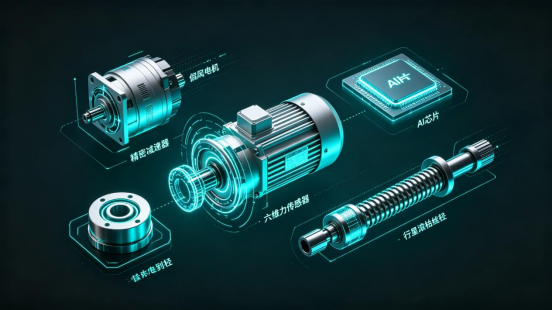
Nevertheless, critical weak links remain prominent. High‑precision six‑axis force‑torque sensors, tactile feedback arrays, heavy‑duty RV reducers and high‑end planetary roller screws still rely on imports. Dedicated edge AI chips and underlying embodied large models represent shared bottlenecks across the entire industry. To sum up in one sentence: we can already manufacture the robot’s body domestically, yet its “brain” and “nervous system” are still playing catch‑up.
Trait 4: Accelerated development of policy‑standard frameworks ushers the industry into a regulated growth phase
On August 24, the Ministry of Industry and Information Technology released the Guidelines for the Development of the National Humanoid Robot Industrial Standard System (2026 Version) (Draft for Comments). It prioritises standards development across six major areas: basic generic technologies, brain‑inspired and intelligent computing, limbs and sub‑components, complete machines and systems, application scenarios, as well as safety and ethics. The guideline targets the formulation of no fewer than 100 humanoid‑robot‑related standards by 2028.
Back in February, the Standard System for Humanoid Robots and Embodied Intelligence (2026 Version) had been officially issued, filling the gap in end‑to‑end industrial‑chain standards in China. The maturing standard framework marks the industry’s transition from unregulated rapid expansion to rule‑based development — a long‑term positive driver for large‑scale commercial rollout and capital‑market valuation.
Ⅲ. Industry Outlook: Three‑Phase Evolution and Structural Edges of China’s Supply Chain
Looking ahead, the commercialisation of humanoid robots is likely to follow a three‑phase trajectory: industrial deployment first, followed by penetration into service sectors, and ultimately general‑purpose embodied intelligence.
Phase I (2026‑2027): Large‑scale rollout within industrial scenarios. High‑structure environments with clear labour‑replacement demand such as automotive manufacturing, 3C electronics and logistics warehousing will witness initial volume growth. Featuring repetitive tasks, controllable operating environments and calculable ROI, these use‑cases serve as the primary testing ground for humanoid robots to evolve from “functional” to “high‑performance”. If Tesla Optimus Gen 3 achieves mass production of 50,000 units as scheduled in 2026, it will act as a critical benchmark for industry‑wide standardisation.
Phase II (2028‑2030): Penetration into commercial‑service scenarios. Semi‑structured sectors including catering, retail, hospitality, elderly care and cleaning will gradually open up. The core bottleneck in this phase lies not in hardware, but in the generalisation capability of embodied‑intelligence models and data accumulation. Only when robots can stably execute multi‑step tasks amid unstructured environments will the market ceiling for service‑oriented applications be genuinely unlocked.
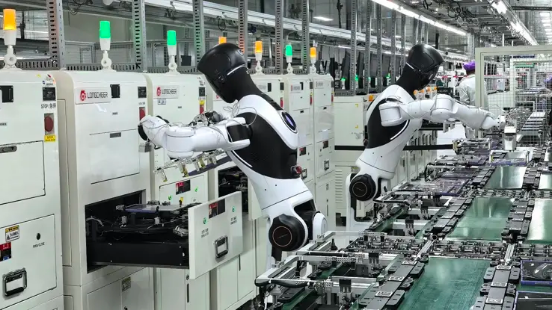
Phase III (Post‑2030): Household‑grade and General‑Purpose Embodied Intelligence. Deployment in domestic settings demands extremely high safety standards, environmental adaptability and cost control. It represents the most challenging yet largest market segment. Drawing on the penetration curves of smartphones and new‑energy vehicles, the climb from 1% to 10% market adoption may take 5 to 8 years. Once the inflection point is crossed, however, growth will turn nonlinear.
China holds structural advantages amid this industrial transformation. The explosive growth of new‑energy vehicles over recent years has built up full‑fledged production capacity for precision motors, gears, lead screws and electronic controls across Guangdong, Jiangsu and Zhejiang provinces. A large share of these supply‑chain resources can be redeployed for humanoid robots as the industry gains momentum. This explains why China accounts for 97% of global humanoid‑robot shipments — far from a coincidence, it is a natural extension of the country’s robust manufacturing foundation.
IV. Investment Strategy: Four Core Investment Themes and the “Pick‑and‑Shovel‑First” Logic
From an investor’s perspective, allocation at the current stage should follow the principle of prioritising certainty while capturing upside elasticity.
Theme 1: Core Components — The Highest‑Certainty Pick‑and‑Shovel Plays
Regardless of which system integrator emerges as the final winner, core components represent an indispensable demand. The investment logic mirrors batteries and motors during the new‑energy‑vehicle boom: sell the shovels first before gold mining begins.
Three high‑potential sub‑segments merit close attention. First, high‑torque joint actuators (motor + reducer + encoder), which account for over 60% of hardware costs. Suppliers such as Inovance and Kinco posted shipment growth exceeding 246% year‑on‑year in Q1 2026 amid surging order volumes. Second, planetary roller screws, the critical components for linear joints. Each robot requires 4‑6 units with a value of RMB 5,000‑8,000 apiece; manufacturers including Wuzhou New Spring have obtained qualification from leading clients. Third, six‑axis force sensors and tactile sensors, the core enablers of force‑control perception. Companies such as Keli Sensing continue expanding revenue exposure to this business.
Theme 2: Leading System Integrators — Selecting Players with Mass‑Production and Commercial‑Deployment Capabilities
The humanoid‑robot original‑equipment market currently features “one frontrunner plus multiple strong competitors”. Tesla Optimus remains the global benchmark, while domestic players including Unitree, Agibot, Ubtech and Xpeng IRON boast differentiated strengths. Three dimensions should be evaluated when investing in system vendors: mass‑delivery capacity, depth of scenario deployment, and proprietary‑technology moats.
Investors should be alert to drastic valuation divergence across integrators. Companies backed by firm orders and proven delivery capacity will attract sustained capital inflows, whereas projects confined to PPT designs and prototype demonstrations face valuation corrections.
Theme 3: Embodied‑Intelligence Algorithms and Data Infrastructure — Long‑Term Value in the “Brain” Layer
If physical components form the robot’s “body”, embodied large models, edge‑side AI chips, simulation training platforms and data‑collection tools constitute its “brain and nervous system”. No dominant technical paradigm has yet taken shape in this segment, yet its long‑term value remains substantial.
Architectures including Moqi Intelligence’s MoRA and Daxiao Robotics’s Enlighten World Model explore distinct technical pathways. Two types of opportunities deserve monitoring: firms with proprietary foundation models that have built closed‑loop product offerings, and infrastructure providers delivering data acquisition, simulation training and model‑deployment toolchains for the whole industry.
Theme 4: Scenario‑Based Applications and System Integration — The Segment Closest to Monetisation
Across industrial manufacturing, logistics warehousing and commercial‑service scenarios, a cohort of enterprises does not manufacture complete robots. Instead, they specialise in integrating robotic hardware into real production lines and business workflows, delivering Robot‑as‑a‑Service (RaaS) solutions. Closer to revenue generation with relatively healthy cash flows, these application‑layer targets merit attention during the inaugural mass‑production year.
Ⅴ. Key Monitoring Metrics: Five Critical Variables to Track Continuously
Bright industry prospects do not justify investment driven purely by narratives. The following five variables shape sector momentum and stock‑level differentiation.
Variable 1: Mass‑Production Timeline of Tesla Optimus Gen3. Tesla’s roadmap continues to set the industry benchmark. Should Gen3 finalise its design and reach the 50,000‑unit production milestone as planned, the entire supply chain will accelerate maturity. Delays, by contrast, could weigh on market sentiment and valuations.
Variable 2: Capacity Ramping and Yield Performance of Core Components. Humanoid‑robot joint modules are produced in low‑to‑medium batches with diversified specifications, without the large‑scale supply‑chain ecosystem seen in the automotive sector. Supply reliability and ramp‑up speed for several core parts remain unproven; production yields directly dictate the pace of cost reduction.
Variable 3: Breakthroughs in Generalisation Capability for Embodied Large Models. Robots deliver acceptable performance within structured environments, yet task‑completion ratios stay volatile under unstructured conditions. The ability of embodied models to achieve cross‑scenario generalisation serves as a prerequisite for unlocking service‑market potential.
Variable 4: Tangible ROI Validation for Commercial Use Cases. Shipments alone are insufficient metrics. Customer repurchase rates and per‑unit return‑on‑investment carry greater weight. If a robot fails to deliver payback within 18‑24 months for enterprise clients, large‑scale adoption will stall. Real‑world operational data from industrial deployments outweigh exhibition‑hall demos.
Variable 5: Valuation Bubbles and Primary‑Secondary Market Arbitrage Risks. With RMB 104.1 billion raised across the sector in H1 2026, valuations for flagship projects have climbed rapidly. Investors must guard against valuations pricing in growth over the next 3‑5 years, as well as inverted spreads where primary‑market valuations exceed comparable listed peers. Investment decisions should anchor on fundamentals rather than sector hype.
Ⅵ. Risk Disclosure: Four Material Risk Factors for Investment Decisions
While the humanoid‑robot industry holds promising long‑term prospects, investors must recognise core risks prevailing at the current development stage. Four major risk factors may materially impact investment returns:
Risk 1: Unproven Industrial ROI — Dual Deterioration in Efficiency and Cost Economics
This short‑term risk remains largely underappreciated. Data released at the 2026 WRC shows humanoid robots achieve merely 50% of a skilled factory worker’s overall operational efficiency for industrial workflows. End‑user system costs stand at RMB 600,000‑700,000 per unit, far above the client affordability threshold of RMB 250,000. Enterprise buyers generally demand an 18‑month payback period, requiring a 60% cost reduction before labour substitution becomes economically viable.
A deeper challenge lies in engineering maturity. A prototype completing a single motion at an exhibition does not guarantee 8,000 hours of failure‑free continuous operation on the factory floor. Full validation cycles for physical prototypes run on weekly or monthly timelines with testing costs often reaching hundreds of thousands of RMB, resulting in far slower iteration cycles compared with traditional industrial robots. Grant Thornton estimates large‑scale industrial adoption will only take off once three conditions align: proven technical performance, cost reduction to critical thresholds, and standardised application scenarios — a transition projected to take 2‑10 years.
Risk 2: Valuation Bubbles and Primary‑Secondary Market Valuation Inversion
Financing totalling RMB 104.1 billion in H1 2026 has driven sharp valuation expansion for leading projects. Unitree Technology once hit a market capitalisation above RMB 400 billion on its IPO date, delivering a ‑20.23% return over the subsequent three months (benchmarked against ChinaAMC CSI Robot ETF Connect A). Three categories of valuation risk require vigilance:
• Primary‑market overhang: Some valuations already price in growth expectations spanning 3‑5 years, creating downside correction risks post‑IPO
• Primary‑secondary inversion: Pre‑money valuations exceeding listed comparables increase the risk of IPO‑day price declines
• Fading thematic momentum: Current trading activity is largely theme‑driven by large addressable markets, novel narratives and event catalysts. Once market focus shifts toward earnings verification, assets lacking firm order backlogs and delivery credentials will face material downward pressure
Risk 3: Technical‑Roadmap Uncertainty — No Convergence in the “Brain” Layer
Multiple competing technical paradigms coexist for embodied‑intelligence algorithms without a consensus industry standard. Moqi Intelligence’s MoRA architecture, Daxiao Robotics’s Enlighten World Model and Tesla’s vision‑first approach each pursue distinct pathways. Unsettled technology trajectories imply:
• Technical‑bet risk for investors targeting algorithm‑layer developers
• Persistent supply‑chain weaknesses for edge‑side AI chips and foundational embodied large models, with extremely low domestic substitution rates
• Volatile task‑success rates in unstructured environments; the timeline for cross‑scenario generalisation remains unpredictable
Risk 4: Supply‑Chain Ramping and Yield Bottlenecks
Humanoid‑robot joint modules run on low‑volume, high‑variety production schedules, lacking the mature mass‑production supply‑chain infrastructure of the automotive industry. Key hurdles for core‑component ramp‑up include:
• A domestic production yield of only 60% for planetary roller screws; high‑end variants still rely on Switzerland‑based GSA
• Six‑axis force sensors deliver ±2% precision, materially trailing overseas‑made alternatives
• The ongoing transition from custom‑built parts to standardised components; economies of scale are yet to be fully realised
Conclusion: An Evaluation Framework for Investors
From the World Robot Conference to the Humanoid Robot Games, the summer of 2026 delivers a clear message: humanoid robots are no longer a conceptual novelty, but a tangible industry entering the phase of mass‑production delivery.
For investors, a concise framework can be adopted to assess opportunities in this track: genuine market demand, declining unit costs, mature application scenarios, and converging technical standards. An authentic industrial inflection point arrives only when all four conditions are satisfied. Hype driven merely by thematic popularity, without cost reductions and real‑world deployment, tends to amount to nothing more than capital‑market fanfare.
At the current stage, we favour the high certainty of pick‑and‑shovel players, identify high‑growth leaders among system integrators, and position for the long‑term value of embodied intelligence, while exercising prudent discipline on valuations. The long‑distance race for the robotics industry has only just begun. The ultimate winners will be enterprises that boast robust technological moats and the capability to translate products into sustainable revenue.
 Jumbo Sheen Fund
Disclaimer:The content involved in this article is for sharing and exchange purposes only, and shall not be construed as investment advice. It is provided merely for readers' reference. All copyrights of the quoted content belong to the original authors. If any infringement is found, please contact us for removal.