
Prev
Click the blue text and follow us
✦
JUMBO SHEEN
INVESTMENT
✦
Pacini × BYD Sign In‑Depth Strategic Cooperation Agreement
Rather than hunting for application scenarios for robots, we deliver solutions for automotive manufacturing
BYD stands as the first true rule‑changer amid the century‑long transformation sweeping the global automotive industry. As the world’s top‑selling new‑energy vehicle manufacturer, its annual sales are set to hit the 5‑million‑unit mark in 2026 — a volume over 1.5 times the combined deliveries of the world’s second‑ and third‑ranked automakers. No pure‑electric player over the past four decades of automotive history has ever achieved such scale, nor has any legacy manufacturing giant matched this milestone during its electrification transition.
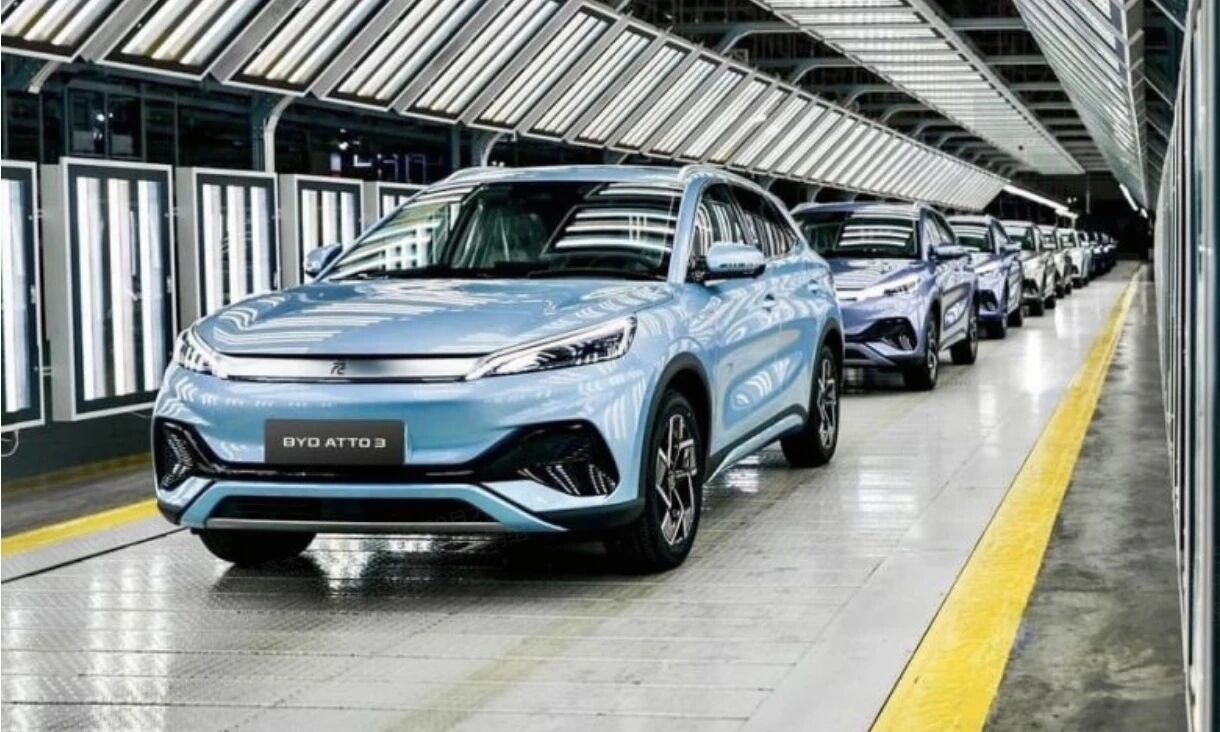
BYD’s vehicle manufacturing bases span the globe, forming the largest, most densely‑process‑driven and tact‑critical super manufacturing complex in automotive history. As this million‑unit‑per‑year industrial powerhouse opens its core production lines to embodied intelligence, what it demands is real‑world productivity capable of perceiving steel panels, paint finishes, wiring harnesses and sealants.
Delivering tailored solutions for automotive manufacturing — Pacini systems are directly deployed at BYD’s critical workstations, integrated into real‑life manual key processes along the sophisticated final assembly line.
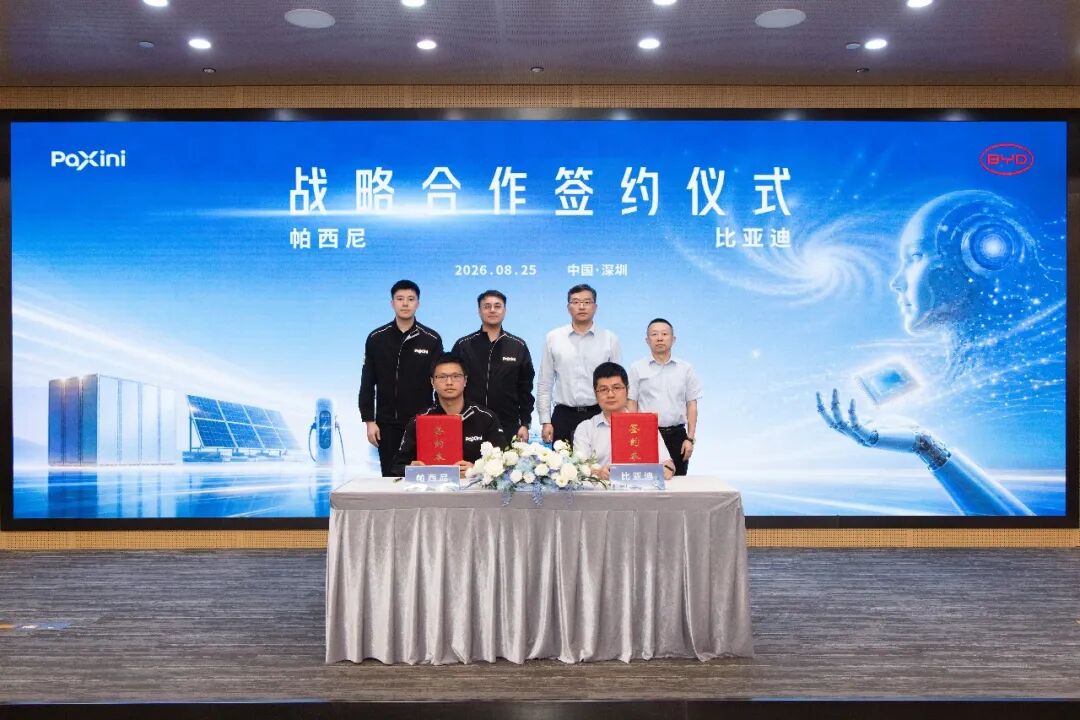
Luo Zhongliang, Vice President of BYD Group, General Manager of the 15th Division and General Manager of the Commercial Vehicle Division; Li Qian, Secretary of the Board of Directors and General Manager of the Investment Department of BYD Group; Dr. Xu Jincheng, Founder and CEO of Pacini; and Nie Xiangru, Co‑Founder of Pacini, attended the ceremony and witnessed the signing. Zhao Weibing, Director of BYD Future Lab, and Luo Xiaoheng, Chief Strategy Officer of Pacini, signed the agreement on behalf of the two parties. Going forward, both sides will deepen data acquisition and jointly build underlying capabilities, enabling embodied intelligence to form a closed‑loop development cycle from validation to capability accumulation through real‑world interaction scenarios.
【Amid Frequent Model‑Switching for Multiple Vehicle Platforms】
【Flexible Production Lines Still Rely on Rigid Manual Tactile Inspection Processes】
With more than 15 brand‑new vehicle models launched each year and dozens of derivative process variants, global manufacturing sites maintain synchronous production at identical takt times. On average, this manufacturing system integrates an entirely new set of process specifications into the same final‑assembly line in less than nine days, without halting conveyors or reducing production cadence. Upstream stamping, welding and painting stations leverage flexible hangers and visual positioning, enabling model changeovers to be completed within two hours. By contrast, downstream final assembly encompasses hundreds of thousands of workstations for fastener snapping, adhesive dispensing, connector plug‑in and component fitting. Operational parameters at these stations require recalibration with every new vehicle variant.
A brand‑new car rolls off the production line globally every 1.4 seconds. At such throughput speeds, teaching machines to replicate human tactile perception becomes critical — while guaranteeing consistent yields across all manufacturing bases. Neither vision‑based systems nor conventional robotic arms can fulfil this requirement. Only tactile embodied intelligence systems capable of measuring force, deformation and contact state are up to the task.
【Driven by Real‑World Demand】
【Pushing Embodied Intelligence into the Core Workflow of Automotive Flexible Manufacturing】
The industrialisation of embodied intelligence should not be about hunting for application scenarios for technology. Instead, it shall start from identifying the real‑world pain points on the production floor, so as to build system‑level capabilities that deliver tangible operational value.
Automotive flexible manufacturing features lengthy workflows, stringent precision requirements and fast production takt times. Component tolerances, material deformation and unexpected operating conditions can occur in combination at any moment. For such high‑density physical‑interaction scenarios, upstream automation only ensures that every part is correctly positioned. By contrast, hundreds of thousands of downstream final‑assembly stations for fastener engagement, adhesive application, connector mating and component fitting still rely heavily on seasoned workers’ millisecond‑level tactile feedback and dexterous skills to judge material stiffness, damping curves and deformation discrepancies. The manipulation techniques and decision‑making logic forged through decades of hands‑on factory experience constitute the core raw data that Pacini aims to capture, translate and consolidate on BYD’s production lines.
BYD defines practical tasks and performance benchmarks, while Pacini delivers solutions through sensing hardware, datasets, AI models and robotic systems. This collaboration drives embodied intelligence beyond peripheral demonstrations and into core manufacturing workflows — shifting the paradigm from “robots being present in factories” to “robots actively participating in production”. Against this backdrop, Pacini has established a clear positioning within the automotive sector: to serve as the foundational sensing and data backbone for embodied intelligence in vehicle final assembly.
【The Automobile Stands as the Jewel of Manufacturing】
【Pacini Equips This Jewel with Tactile Nerves】
Connector plug‑in, fastener pressing and pipeline docking on automotive final‑assembly lines do not depend on rigid positioning. Instead, they rely on the delicate sense of proportion unique to human fingers. Pacini replicates this very tactile dexterity for machines through tactile‑based flexible force control, standardising it into production‑grade benchmark tactile capabilities.
Vision systems only address what can be seen. Pacini delivers the ability to touch accurately and apply force deftly. Deployed on BYD’s live production lines, Pacini has become the only player to complete data acquisition and validation within a real smart‑manufacturing environment. This core, one‑of‑a‑kind validated capability underpins the end‑to‑end expansion of the partnership.
On the data front, both parties will build full‑stack capabilities for the collection, governance and application of industrial embodied data throughout manufacturing workflows, continuously improving the accumulation and utilisation efficiency of high‑quality datasets.
On the production front, multi‑dimensional tactile sensors and corresponding perception technologies will be further integrated into manufacturing processes. Richer physical interaction data will support the intelligent and digital upgrading of production lines.
In addition, the two sides will jointly pursue special projects including the real‑world training initiative for humanoid robots and embodied intelligence led by the MIIT and the State‑owned Assets Supervision and Administration Commission. Real‑world production practices will be refined into verifiable, reusable industrial outcomes, extending the cooperation from in‑house use‑cases toward industry‑wide practical experience.
No tactile sensing, no true embodiment. Through real‑world physical interaction, Pacini enables tactile nerve capabilities to gradually evolve into the “muscle memory” of production lines. Its scenario‑based data acquisition solutions can potentially be scaled from a single line across entire manufacturing ecosystems.
Conclusion
The in‑depth collaboration between Pacini and BYD marks an irreversible upgrade in the role of Pacini’s tactile technology within automotive manufacturing. Powered by multi‑dimensional tactile perception, embodied datasets and process models, its capabilities have become permanently embedded into non‑standard workstations for final assembly. Going forward, Pacini will deploy its full‑stack technology deep into the manufacturing systems of the world’s leading automakers. The data standards and process paradigms refined in advanced‑manufacturing scenarios will be established as industry benchmarks for the global automotive sector.
 Jumbo Sheen Fund
Disclaimer:The content involved in this article is for sharing and exchange purposes only, and shall not be construed as investment advice. It is provided merely for readers' reference. All copyrights of the quoted content belong to the original authors. If any infringement is found, please contact us for removal.